

Environment Agency Treatment Programme - Main Rivers of Yorkshire
A look into the Environment Agency’s large scale INNS treatment programme for Japanese knotweed, giant hogweed and floating pennywort by Andy Virtue, EA.
In Yorkshire the Asset Performance team at the Environment Agency take our responsibilities with respect to Invasive Non-Native Species (INNS) very seriously. Legally, it is the responsibility of the riparian owner to treat INNS on their own land. As a result we routinely treat Japanese knotweed and giant hogweed on our land and assets. We also work in partnership with the Canal & Rivers Trust (CRT) to treat all the floating pennywort on the rivers and canals of South and West Yorkshire. We believe that these three species pose a real or potential impact on our ability to manage our flood-defence assets and prevent flooding.
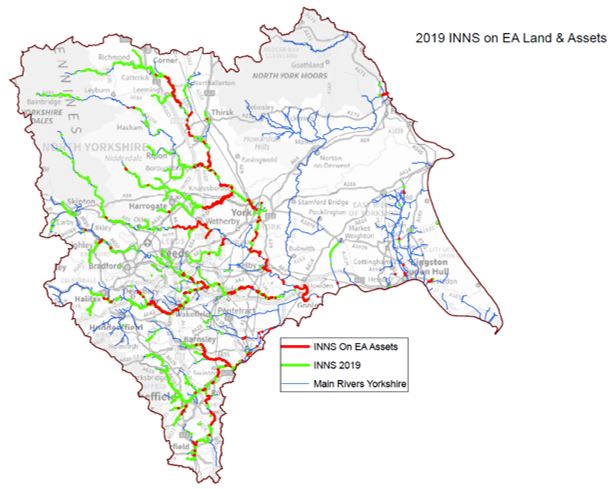
Most Environment Agency land and assets are along lowland rivers. This leaves them at risk of being infected from upstream areas that are not being treated. In Yorkshire we take the view that it does not always make sense to treat our sections in isolation. If we did we would have a constant drip-feed of INNS from upstream.
Whilst we always encourage landowners to treat their own INNS infections, we are aware that in many areas landowner engagement programmes are not yet in place. Where this is the case the Environment Agency may treat these species when they occur on main rivers. We are doing this to reduce flood risk. If Japanese knotweed spreads to our land it may damage our assets. If giant hogweed spreads to our land or assets it may reduce the ability of our operatives to safely undertake maintenance work. Our long-term goal is to see that our programme is replaced or supported by landowner pay-in schemes that contribute to treatment costs.
We have been funding the treatment of these INNS along the whole of the River Aire since 2015. In this time we have seen a reduction in the amount of both these species along this river. In 2019 we extended our programme to include all the main rivers of the Don catchment. In 2020 it will be extended further, to include the treatment of giant hogweed (and potentially Japanese knotweed) on all main rivers of the North and East of Yorkshire, plus sections of the River Calder.
Key Points

Andrew Virtue
andrew.virtue@environment-agency.gov.uk
